
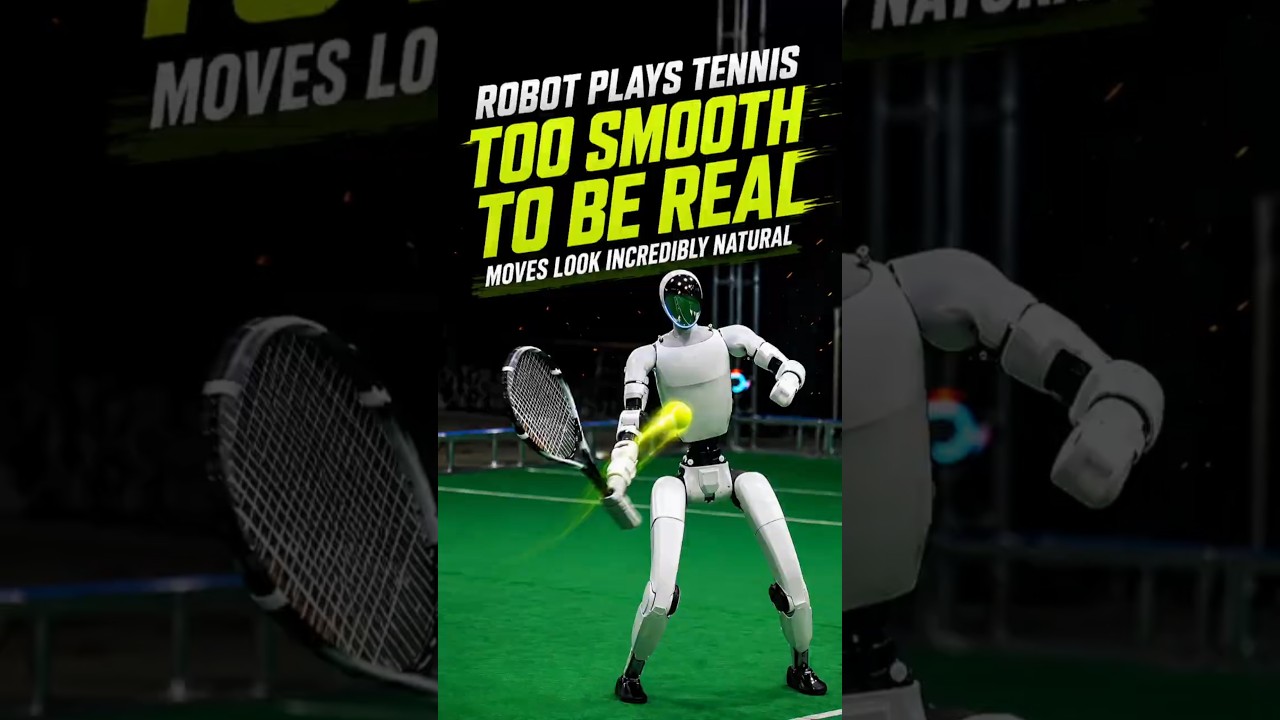
A tennis court is a demanding stage. The surface rewards exact positioning, the ball punishes late reactions, and the best players seem to move before the shot is even struck. Now put a robot on that stage. In a short vertical video, one glides across the baseline, reads an incoming ball, and arrives in time — not as a trick of editing, but as a coordinated answer to the oldest problem in sports: get to the right place before the ball does.
Step back and the clip becomes less about tennis and more about three separate problems being solved at once. The first is seeing. A machine has to find a fuzzy yellow sphere traveling fast against a shifting background, then keep finding it dozens of times per second. Human eyes do this effortlessly; cameras and vision models have to work for it.
The second problem is deciding. Knowing where the ball will land is worthless until the machine commits to a plan: pick an intercept point, choose a path, budget its own speed, and start — knowing it may need to revise everything a moment later. Watch the clip again and you can almost see this happen. There is a beat where the robot shifts its weight, and from then on the outcome is already determined.
The third problem is the hardest to fake: moving. Courts are big, rallies are short, and every step matters. What looks like simple rolling is actually constant correction — acceleration, braking, micro-adjustments of stance, all timed so the machine is balanced at the moment of contact rather than merely nearby. Deftness, it turns out, is mostly timing.
It helps to compare this with the robot most people picture: the industrial arm. An arm repeats. It performs the same motion in the same place to a tolerance of fractions of a millimeter, and it does so brilliantly — inside a world that never changes. A tennis court is the opposite of that world. Nothing repeats. Every ball arrives with different speed, spin, and bounce. Repetition is useless; adaptation is everything.
That distinction is why robotics demonstrations keep gravitating toward sports. A rally compresses every hard part of the field — perception, prediction, planning, balance, control — into a few audible, visible seconds that anyone can grade. You do not need to read a whitepaper to know whether a machine got to the ball. It either did or it didn’t.
There is also something quietly radical in how ordinary the hardware appears. For decades, responsive machines needed rooms of processors and cables tethered to a wall. Machines that move like this carry their computing with them, running the entire see-decide-move loop fast enough to be useful against a ball that gives no second chances.
How does a machine get this good? Not by being programmed line by line, for the most part. Modern systems train — running through enormous numbers of simulated rallies where every mistake costs nothing but time, refining the perception models and movement policies until the real world stops surprising them. Then engineers do the unglamorous part: testing on actual courts, in actual light, until the simulation’s habits survive contact with grass-dust, glare, and drag.
The result sits in an awkward, interesting category: better than most people expect, worse than professionals, and improving on a schedule that used to belong to software rather than to bodies. When capability crosses that line from “impressive for a robot” to “impressive, full stop,” demos like this one are what the before picture will look like.
The same loop, running less glamorously, is what the next generation of machines will need everywhere: a warehouse bot that re-plans when a pallet appears in its lane, a hospital courier that slows for an unexpected wheelchair, a delivery vehicle that decides the curb is too crowded and waits. None of those scenes make good video. A tennis court does — which is precisely why it gets filmed.
None of this means tennis pros should worry about their jobs. A skilled junior would still outplay the machine in a real match, and the demo is, in the end, a demo. But the gap it closes is not the one against human players. It is the one against the machines of five or ten years ago — the ones that could repeat flawlessly and respond to nothing.
So enjoy the clip for what it is: a machine making a decision and moving deftly on a tennis court, in public, without a net of scripting holding it up. Then notice how unbothered it looks while doing so. Calm, in robotics, is not the absence of effort. It is effort hidden by software that works.